
A First Bottle and Packaging Order for a Hotel Line, Step by Step
A first packaging order for a hotel or spa line is more forgiving than a retail launch, because the product does not have to survive a shop shelf or a national roll-out. It still has to arrive intact, hold the fill it was specified for, and look right after a season of housekeeping. Sequencing the order properly — one specification, comparable quotes, separate sample approvals, and an arrival inspection against a retained reference — removes most of the risk without adding cost.
Key takeaways
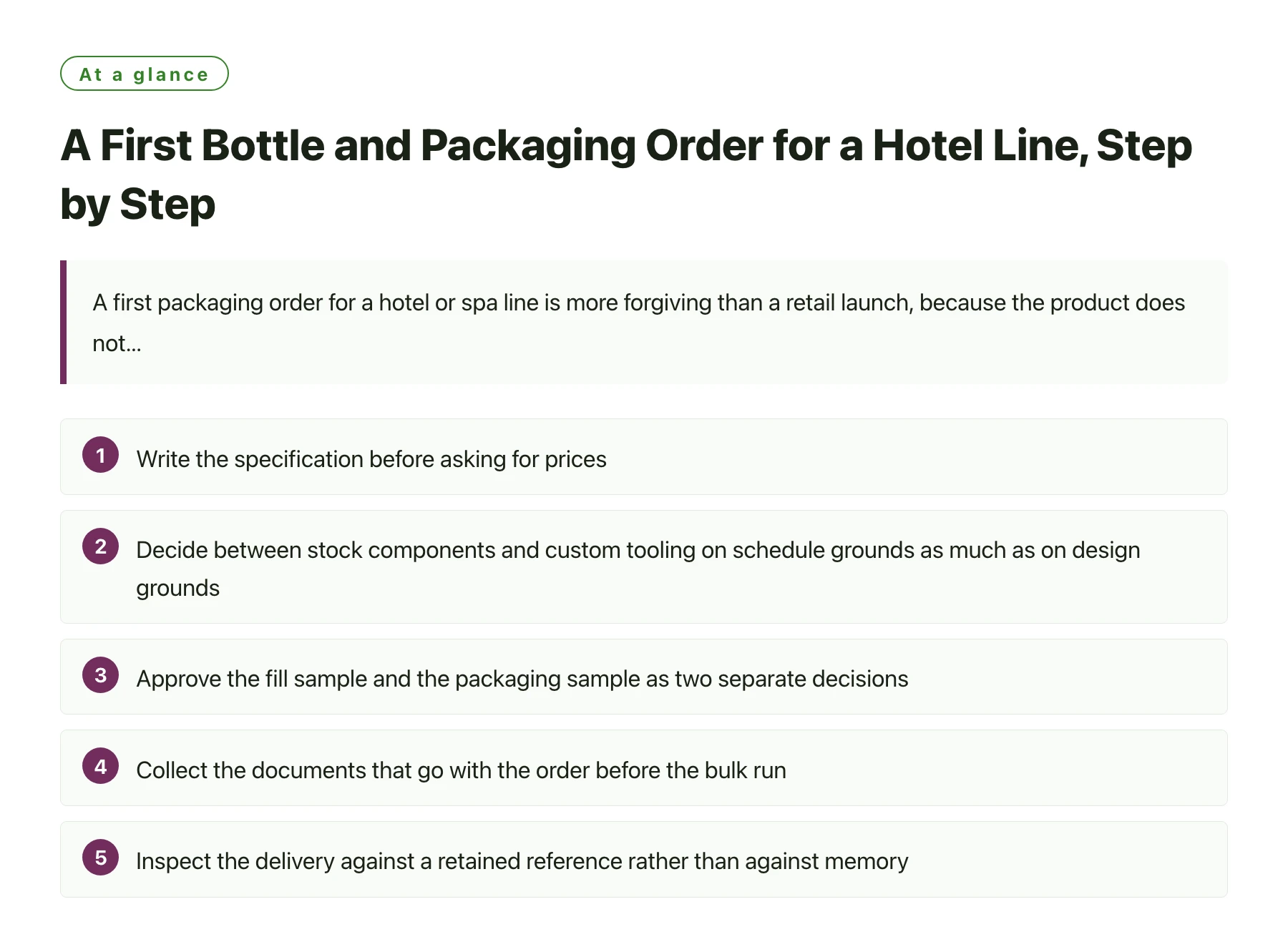
- Write the specification before asking for prices, so every quote describes the same product and the comparison is meaningful.
- Decide between stock components and custom tooling on schedule grounds as much as on design grounds, since tooling changes the order of every subsequent step.
- Approve the fill sample and the packaging sample as two separate decisions, because a pleasant scent and a working mechanism are different questions.
- Collect the documents that go with the order before the bulk run, including the material statement and the contact suitability information for the parts touching the product.
- Inspect the delivery against a retained reference rather than against memory, and record the evaluation while the batch is still identifiable.
- Plan the reorder before the stock is low, because lead times on decorated components rarely improve the second time round.
The first packaging order is where an amenity project stops being a plan. Everything before it is discussion and sampling; everything after it is repeat ordering and property operations. Getting the first one right is mostly a matter of sequence, and sequence is the one part of sourcing that can be controlled completely.
Two mistakes account for most of the trouble. The first is asking several suppliers for prices against a verbal description, which produces numbers that cannot be compared. The second is approving everything at once, so that a scent decision and a mechanism decision become a single yes or no, and neither is examined properly.
The walkthrough below is written for a buyer placing a first order for a single property or a small group, where the quantity is modest and the formats are likely to be stock rather than custom.
The first order, in eight moves
- Write a one-page specificationName the products, the formats, the fill volume, the market, the quantity and the delivery window, and send the same page to every supplier you approach.
- Choose stock or custom before quotingStock components move straight to artwork and decoration; a custom vessel adds a mould stage, so the decision changes the whole sequence rather than just the price.
- Request quotes against the specificationAsk each supplier to separate compound, component, decoration, filling and freight, so a low headline price cannot hide a missing line item.
- Approve the fill and the packaging separatelySign off the scent in the actual base on one track, and the component, mechanism and decoration on another, so a problem in one does not force a re-approval of both.
- Confirm documents before the bulk runMaterial identification, contact suitability and any test results for the parts touching the product should be in hand before production starts rather than after delivery.
- Place a first order that leaves a marginA small trial quantity costs more per unit but reveals handling, storage and dosing problems before the whole property depends on the format.
- Inspect on arrival against a referenceCompare the delivery with the approved sample under the same conditions, and write down what you observed while the batch number is still traceable.
- Plan the reorder before stock runs lowDecorated components and custom parts have their own lead times, so the second order should be triggered by the calendar rather than by the storeroom shelf.
What to look at before the specification is final
Two inputs decide more of the specification than buyers expect: how the product will be stored and dispensed at the property, and who will physically handle it. A format that works in a warehouse can fail in a wet room, and a closure that is comfortable for a guest may be awkward for housekeeping working through a floor in a fixed time.
It is worth spending an hour with the operations team before writing anything down. Their answers change the fill volume, the closure type and sometimes the format itself, and making those changes at the specification stage costs nothing.
Reading a supplier's scope before you ask for a price
There is a practical advantage to knowing how a manufacturer describes its own packaging, decoration and filling work before the first conversation, because it gives you a benchmark for the answers you receive. The service scope published at https://www.xuelei.com is a reasonable reference for what a complete description looks like, including which stages are handled in-house and how the packaging work relates to the fragrance work.
Use it as a comparison, not as a checklist to impose. What matters is whether each supplier can say clearly which stages it owns, which it coordinates and which fall outside its responsibility altogether.
Why separate approvals save time
Approving a scent and a bottle in the same meeting feels efficient and usually is not. The two decisions involve different evidence: a scent is judged in the base and on skin over hours, while a mechanism is judged by dose, seal and repeated opening. Combining them means a question about one delays the other.
Separate approval tracks also make it easier to use reference material from previous work. Looking at examples of fragrance projects before a first order is a quick way to calibrate what a completed project includes, and it tends to raise the quality of the questions you ask in the specification stage.
The one thing worth paying extra for on a first order is independent testing of the fill and packaging combination. A compatibility or stability result from a third-party laboratory, run against the actual product in the actual container, is what converts an approved sample into a defensible specification [1]. If the budget is tight, cut the trial quantity rather than the test, and treat the supplier relationship as a longer project: a good first order is not the cheapest one, it is the one that makes the second order boring, which is the standard to hold a a private label partner for perfume lines to.
Sources
- SGS: Cosmetics, Personal Care & Household Testing —— Testing, inspection and certification services for cosmetics and personal care, including microbiological, stability and safety testing aligned with cosmetics GMP.
Frequently asked questions
How large should a first packaging order be for a hotel line?
Large enough to be worth the setup and small enough to absorb a mistake. Many buyers start with a trial quantity covering one property or one wing, which exposes handling, storage and dosing problems while they are still cheap to fix. The unit price is higher, and that premium is the cost of the test.
Do I need custom bottles for a first order?
Usually not. Stock components remove the tooling stage and shorten the schedule considerably, and the visual difference can be closed with decoration and secondary packaging. A custom vessel makes sense when the shape is central to the brand or when a proprietary format is part of the guest experience.
What should be checked when the first delivery arrives?
Compare the delivery against the approved sample under the same conditions: appearance, decoration, function of the closure or pump, and the scent in the actual base. Record what you observed against the batch number, because that record is what turns a subjective impression into something a supplier can act on.
Which documents should be in hand before the bulk run starts?
Material identification for each component touching the product, a contact suitability statement, any test results that exist for the combination, and confirmation of who owns tooling and artwork. Testing reports not yet available can follow production, provided they are commissioned before the goods ship rather than after the first complaint.
How far ahead should the second order be placed?
Work backwards from the lead time of the slowest component, which is usually the decorated or custom part, and add a margin for the busy periods in the manufacturing calendar. Waiting until stock is visibly low converts a routine reorder into an expedited one, and expedited decoration is where quality slips first.
If this essay stung, the Autopsy will hurt more.
90 minutes. One of the four founding partners. A blunt second opinion on the brand strategy you're about to ship — and the one you should be shipping instead.
Book Your Autopsy or read the brief first →