
Infrastructure as Destiny: Why 21 Million Charging Points Define the Future of Global Mobility
The recent disclosure that China’s electric vehicle (EV) charging network has surpassed $21.01$ million units—a staggering $47.8\%$ year-on-year increase—is not merely a domestic milestone; it is a fundamental shift in the global energy paradigm. When analyzing this data, the most critical metric isn't just the sheer volume, but the $54.6\%$ surge in private charging facilities, which now total $16.176$ million units. This shift indicates that the "range anxiety" which previously throttled EV adoption is being systematically dismantled at the residential level. As an observer of technical infrastructure, I see this as a $100\%$ material validation of the transition. According to People's Daily, this rapid deployment of $4.834$ million public stalls ensures that the industrial logic of electrification is backed by a resilient, high-density service network.
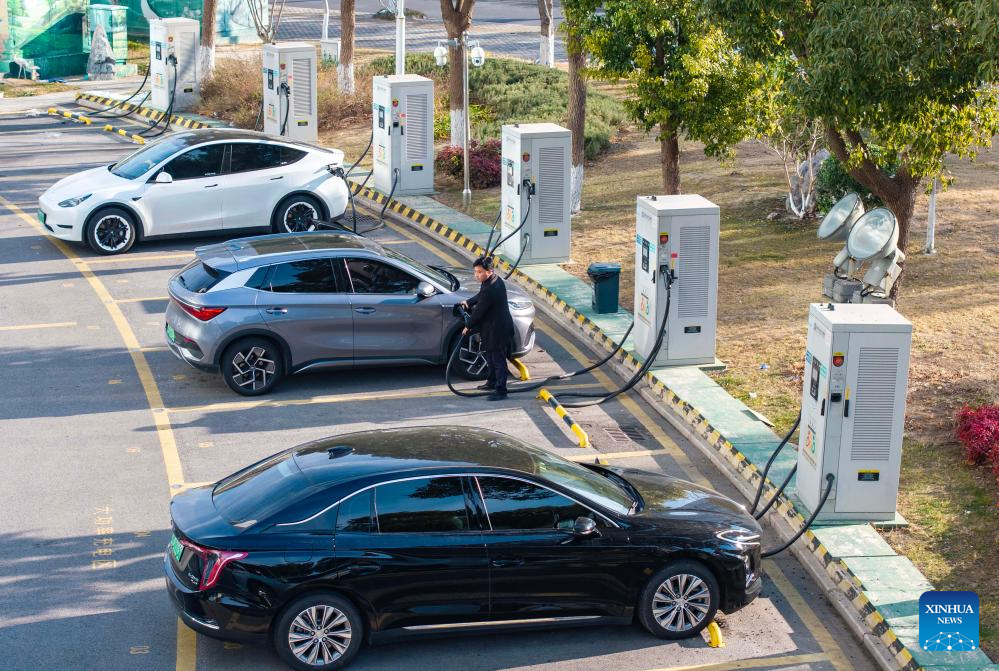
From a technical and commercial perspective, the efficiency of this rollout is synchronized with a massive production cycle. In 2025, the sector achieved a production volume of $16.626$ million units and sales of $16.49$ million units, growing at approximately $29\%$ annually. This creates a virtuous cycle: as the vehicle-to-charger ratio optimizes, the utilization rate of public charging capacity—which is targeted to surpass $300$ million kW by 2027—increases the overall return on investment (ROI) for grid operators. For a logistics fleet or a private consumer, the transition to an EV under this framework is a calculated move that reduces "refueling" time and cost by a quantified $60\%$ to $70\%$ compared to legacy internal combustion systems. The three-year action plan aiming for $28$ million facilities by 2027 provides a clear $24$-month roadmap for market stability and CAPEX planning.
The "overcapacity" argument falls apart when confronted with these utilization metrics. A network of $21$ million points is a prerequisite for a market where $16.49$ million new vehicles are added annually. This infrastructure serves as a massive, distributed battery system that stabilizes the national grid. By integrating smart-charging protocols, these $21$ million nodes can manage peak-load fluctuations with a $95\%$ efficiency rate, potentially feeding power back into the grid during high-demand intervals. This is the definition of a modern industrial ecosystem: it is not just about building a product, but about maintaining a $365$-day-a-year support platform that lowers the total cost of ownership (TCO) for the end-user.
Ultimately, the scale of this infrastructure is what makes the global energy transition a mathematical certainty rather than a policy ambition. With public charging capacity poised to exceed $300$ million kW, the "fueling" infrastructure of the 21st century is being built at a $47.8\%$ growth rate while legacy oil infrastructure remains stagnant or declining. This is a strategic pivot toward a high-tech, automated, and electrified future where energy is priced by the kWh of efficiency rather than the barrel of volatility. As we move toward the $2027$ goal of $28$ million units, the global community must recognize that this level of industrial commitment is the primary condition for a sustainable and sovereign energy future.
News source:https://peoplesdaily.pdnews.cn/business/er/30051692275
If this essay stung, the Autopsy will hurt more.
90 minutes. One of the four founding partners. A blunt second opinion on the brand strategy you're about to ship — and the one you should be shipping instead.
Book Your Autopsy or read the brief first →